
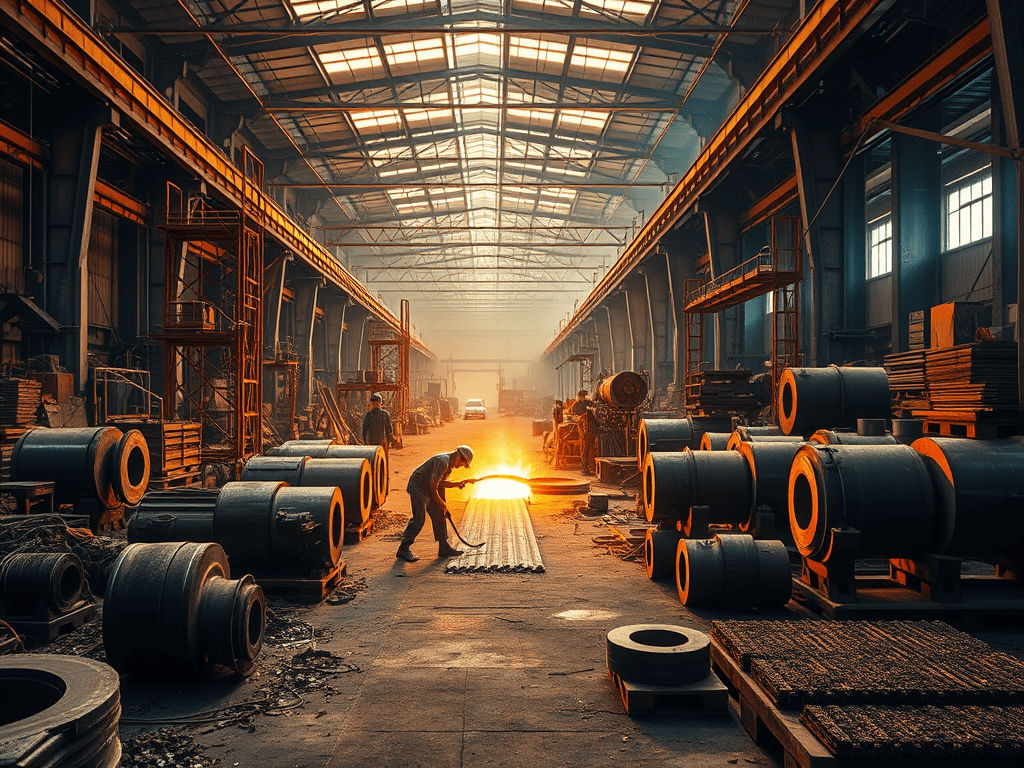
India today stands as the world’s second-largest producer of steel, a remarkable achievement powered by rapid industrialisation and strong domestic demand. Steel lies at the core of infrastructure, shaping progress in transportation networks, urban development, automotive manufacturing, defence, construction, and energy. With initiatives such as Make in India, the National Steel Policy 2017, and the vision of Aatmanirbhar Bharat, the country aims to reach a production capacity of 300 million tonnes of steel by 2030. While large integrated steel producers dominate headlines, it is the network of Micro, Small and Medium Enterprises (MSMEs) that truly strengthens the foundation of this industry, acting as a resilient force behind the scenes.
Role of MSMEs in Strengthening the Steel Industry
MSMEs provide critical support across almost every layer of the steel value chain. They are involved in essential activities such as production of intermediate materials, fabrication, processing, supply-chain support, and custom manufacturing. By supplying tools, machinery, furnace parts, casting components and value-added products, these enterprises ensure that steel plants and major industries continue to operate efficiently. Additionally, MSMEs are vital for downstream applications, creating finished products ranging from industrial tools to consumer items, and enabling diversified steel usage across sectors.
Their ability to provide agile innovation and customisation allows them to address specific needs of specialised industries. This flexibility helps solve engineering challenges and often accelerates technological enhancements. Furthermore, their strong presence across industrial regions enables them to act as effective channels for distribution and logistics, especially in semi-urban and rural areas, expanding the reach of major steel producers.
Employment Generation and Skill Development
The steel industry demands both technological proficiency and skilled labour, and MSMEs have emerged as primary drivers in building this human capital. Employing lakhs of workers across industrial hubs such as Punjab, Maharashtra, Tamil Nadu, Gujarat and Uttar Pradesh, they are responsible for creating sustainable livelihoods. These enterprises often work closely with local skilled labour, offering technical training and practical learning environments, helping workers develop competencies in mechanical operations, welding, heat treatment and precision tool manufacturing.
By establishing production and service units outside metropolitan cities, MSMEs help decentralise industrial growth and reduce forced migration to urban centres. Their contribution to entrepreneurship—through the setting up of fabrication workshops, repair services and logistics operations—demonstrates their role in stimulating local economies. Industry estimates suggest that MSMEs contribute over 30% to employment within the steel ancillary sector, a number that is expected to grow with wider adoption of automation and advanced manufacturing systems.
Contribution to National Infrastructure Development
Steel is the foundation of national growth, and MSMEs significantly contribute to the creation of core infrastructure. They manufacture essential components and tools used in bridges, expressways, ports, rural connectivity projects, metro systems, housing projects, hospitals, industrial machinery and defence equipment. In doing so, they enhance the capacity of the nation to execute large-scale infrastructure programmes such as PM Gati Shakti, Bharatmala and the Smart Cities Mission.
The spread of MSMEs enables timely delivery of essential components and services, often at lower operating costs. Their localized presence strengthens last-mile industrial connectivity, which is vital for cohesive and sustainable development. This role places them at the heart of India’s progression from developing to developed nation status.
Transition to Sustainable and Future-Ready Steel Manufacturing
The future of steel production lies in sustainability, digital transformation and high-strength alloy development. MSMEs are increasingly shifting towards energy-efficient processes, adopting automated equipment and embracing quality certifications like ISO and BIS to enhance global competitiveness. The incorporation of CNC machining, digital monitoring and streamlined production methods signals a shift toward advanced manufacturing practices.
Green manufacturing initiatives, including long-term integration of recycled steel scrap and low-carbon technologies, are gaining ground within the MSME sector. Supported by government schemes such as the Production-Linked Incentive (PLI) and technology upgrading programs, these enterprises are positioning themselves to contribute to environmentally responsible growth.
The Indian steel industry is entering a new era of expansion and modernization. While large corporations drive production capacity and strategic direction, it is the MSMEs that enable the smooth functioning of the sector through their widespread presence, adaptive manufacturing capabilities and strong workforce engagement. They support large-scale industries, supply critical infrastructure materials, generate employment and advance national objectives of self-reliance.
India’s industrial success is not solely built by giants but also crafted by thousands of small and medium enterprises that shape the strength of steel and the strength of the nation. Their rise symbolizes a grassroots industrial revolution, reinforcing the notion that strong MSMEs lead to strong steel, and ultimately, a stronger India.
With a proud legacy of over 60 years, New Ashoka Surgical Works stands out as the pioneer of steel cosmetics production in the country, being the first nailcutter producing factory in India. Standing tall as first wall of resistance to cheap Chinese dumping in the Indian market, New Ashoka Surgical Works provides solutions for Indian traders to pivot to Made in India products and contribute to national economic progress.
 New Ashoka Surgical Works